

Home › Owner’s Representative
Service
Owner’s Representative Services
Every other party in a construction project has professional representation. This is ours, on your behalf, from scope through occupancy.
Someone on your side of the table
In a public safety construction project, every other party has professional representation. The architect has a contract and a firm behind it. The construction manager has estimators and schedulers. The subcontractors have their own interests. The owner is usually a city manager, a chief, or a facilities director already carrying a full-time job, and frequently has no one whose sole responsibility is to represent that interest.
That is the role we fill. As owner’s representative we sit on the client’s side from the earliest scope conversation through occupancy, translating between the operational people who will use the building and the technical people who will deliver it, and holding the project to what was actually agreed.
Scope of service
What we do on your behalf
Scope and program definition
Establishing what the project actually is before it goes to market: the operational program, the site, the phasing, the budget envelope, and the constraints that will govern every subsequent decision.
Procurement documents
Preparation of requests for qualifications and requests for proposals for design, construction management, and specialty services, written so that responses are comparable and the evaluation criteria reflect what the owner actually values.
Selection support
Evaluation criteria and scoring frameworks, submittal review, interview structure, reference verification, and negotiation support through contract execution.
Design review
Reviewing each design phase against the approved program and operational requirements, catching the divergences that are inexpensive to fix on paper and expensive to fix in the field.
Budget and schedule oversight
Independent review of estimates, change order evaluation, schedule monitoring against the critical path, and clear reporting to the governing body throughout.
Transition and occupancy
Furniture, fixtures and equipment planning, technology cutover coordination, commissioning support, move sequencing, and close-out, so that operations continue uninterrupted through the transition.
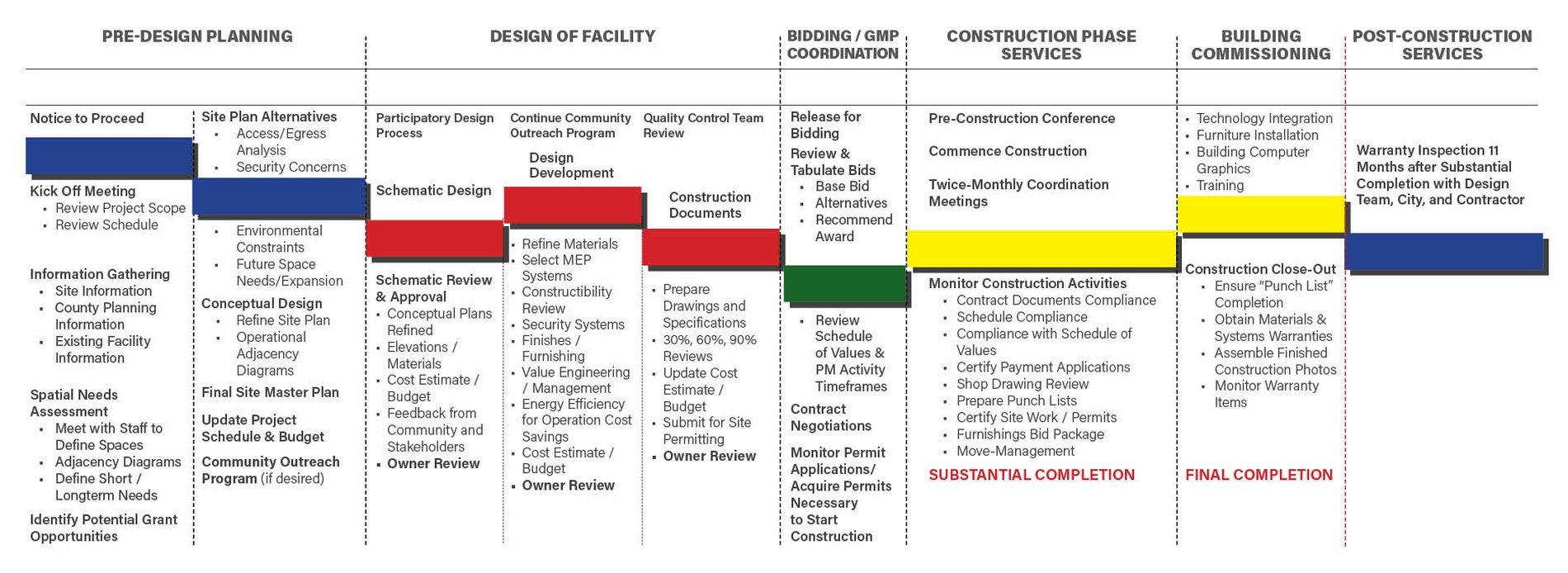
The arc of a project
Where the owner’s representative sits
We are engaged across the whole of this sequence, not only the construction phase, because most of the decisions that determine cost and fitness are made in the first two columns.
Public safety buildings are not ordinary buildings.
They run continuously. They hold evidence whose chain of custody must survive a defense attorney. They separate the public from people in custody, and both from the staff. They house equipment and communications infrastructure that cannot go down. They must remain operable when everything around them has failed.
A design team without significant public safety experience will produce a handsome building that gets these details wrong, and the errors will not be discovered until the agency has moved in. Our role includes ensuring the operational requirements survive contact with the design process. The evidence suite still has to work the way the property clerk needs it to, the sally port sequence has to be right, the dispatch floor has to be staffable at surge, and the building has to have somewhere to grow.
Start the conversation
Tell us what your agency is facing.
Whether you are preparing a budget request, responding to a growth pressure, or standing at the beginning of a facility project, a short conversation is usually enough to tell you whether a study is the right next step, and what it would involve.